Another F Word – Flashbacks

“The subconscious mind cannot delineate between what is actually happening and what are your thoughts.”  ~ Dr. Wayne Dyer

This can be a radical concept to try to embrace. But if we can wrap our minds around it, it gives us release and understanding of our traumatic flashbacks.

I was listening to a recording of Dr. Wayne Dyer this week, when he spoke those words. It resonated with me, especially in regard to flashbacks. When we experience a flashback, our subconscious mind may think the trauma is actually happening, or about to happen, again. We may feel powerless to a flashback. But realizing that it is from our own thoughts ultimately gives us power over it.

person-768478_1280

Often when we are initially traumatized, the mind separates from the body. Psychologists refer to this as dissociation. It can occur again during flashbacks. When your body is not a safe place to be, part of you leaves. This is an innate survival mechanism we have, but it is also why people subjected to repeated, ongoing trauma, need specific healing modalities to re-join these fractured parts of themselves.

After the trauma, we sometimes have flashbacks when triggered by certain sights, smells, sounds or situations. Initially, triggers are common and frequent, growing less powerful as time passes, as we heal and move on from the trauma.

In an article entitled “Trauma and Dissociation: Nuerological and Spiritual Perspectives” in the Journal of Psychology & Psychotherapy, Jane A. Simington writes,

“In Shamanic belief, when the mind separates from the body, as happens during dissociation, the human soul can fracture. When this happens, a part or parts of the soul can remain at the scene of the trauma, as thought frozen there in that space and time. From within this perspective, a trigger is viewed as a signal to the person to pay attention to an unhealed soul wound. A flashback is acknowledged as a step on the healing journey, for it takes the traumatized person back to the traumatic scene where the fractured-off soul parts remain.”

This is a unique way to reframe triggers and flashbacks. If you are still triggered by a certain smell, it is simply a signal that you have more work to do. It doesn’t mean you are lacking in any way, or that you’ve been slacking on your healing process, it’s just a noticing.

And to think of a flashback as a step on the healing journey is a radical idea to most of us as well. But when we return to that scene, we have the opportunity to heal it, to observe yourself in that situation and love yourself. To take the Divine with you, and let the Divine hold you.

A couple of months after I was raped, I moved into a house with 3 roommates and got a dog. That was a good and natural response. I was getting better at sleeping, just knowing there were people around. My roommates didn’t know what had happened to me as I was not sharing it at that time. One of my male roommates thought it would be funny to sneak up behind me in the hall one night and grab my waist and scare me. The next thing I knew, I had left my body (again) and was staring down at myself, screaming loudly, in a fetal position on the floor. It took a few minutes for me to re-enter the present moment and re-enter my body. My roommate was, needless to say, shocked, but realized what had happened. He was extremely apologetic and asked me gently, “That wasn’t just from this, was it?” I could only shake my head, “No.”

How was this a step on my healing journey? Because during my initial trauma, I never got to scream. Being able to scream out all that fear was immensely cathartic.

The next day I felt lighter. I had got back a little piece of my power.

In this same way, therapists working with war veterans are now using simulators to go back to war situations and come back to their present reality, to reduce symptoms of PTSD and work toward feeling safe again. Therapists often also use hypnotherapy as a form of safe flashback to do the same kind of work.

So as scary as flashbacks can be, if we can reframe them as a healing step, we need not fear them. Not that we need to invite them, but when they do come, try to see what message they are bringing. Do I need more therapy? Do I need to journal more? Be with nature? Find safe places? What is Spirit trying to tell me? If you ask the question, you will know the answer.

While we don’t want to live in the past, sometimes we have to address it in order to heal it.

“I am as God created me. In this one thought is all the past undone; the present saved to quietly extend into a timeless future.”  ~A Course in Miracles

You are Still Beloved –

Victoria McGee
A Trauma Survivor’s Manifesto

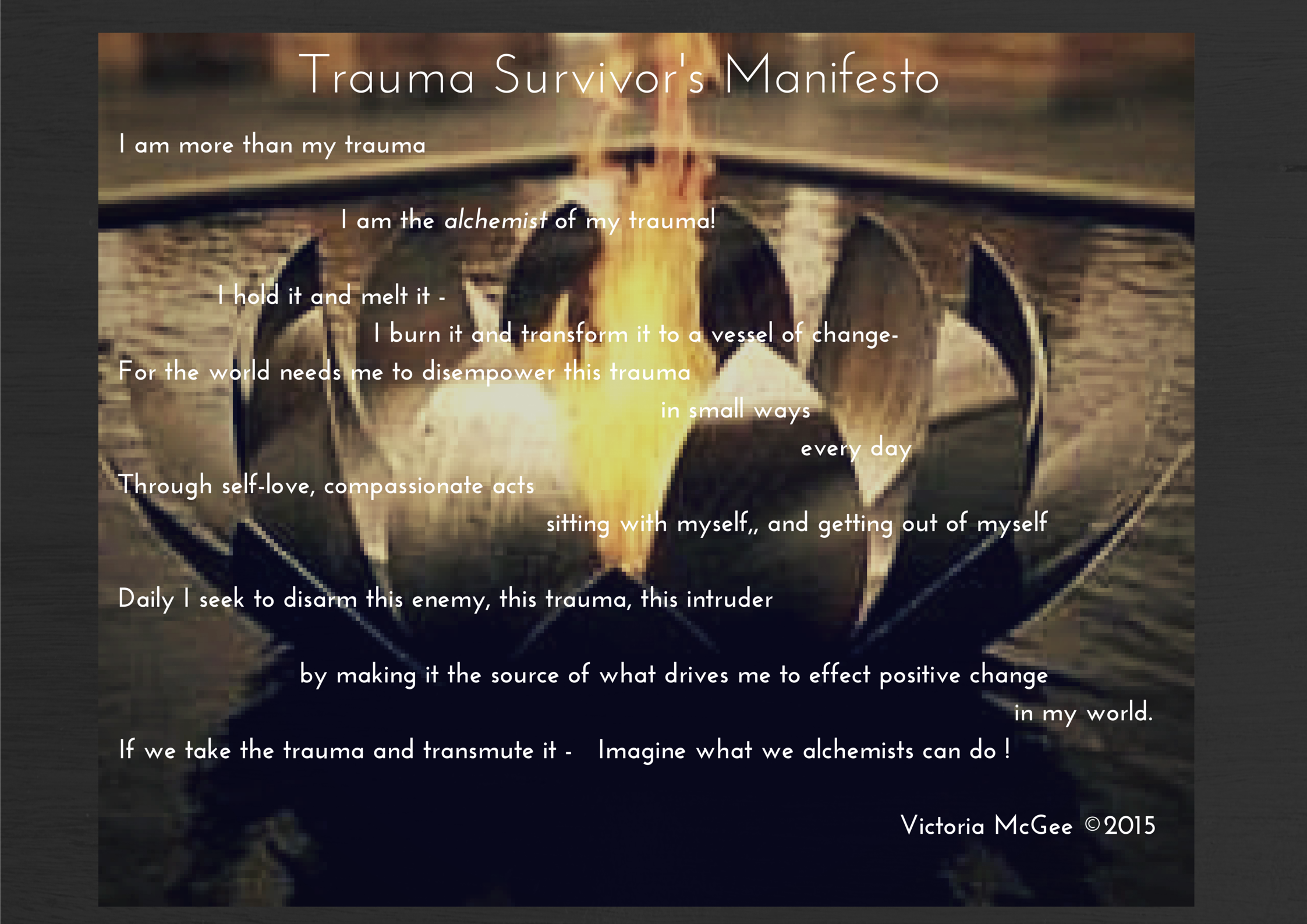
I’ve been thinking about writing this for a while now. I keep being drawn to this idea of taking our trauma, our wounds, and transmuting it into something better. I look at parents who have lost children who take that grief and start foundations, channeling that immense loss into something new and good.

There is no better balm for trauma than creating your own compassionate acts.

So I give this to you today – I hope you find it valuable. Please feel free to share it with others who need these words via Facebook or Twitter!   Click on the picture to enlarge it!

Trauma Survivor's Manifesto

You are Still Beloved ~

Victoria McGee

Oct. 6, 2015

UNDERSTANDING THE INCONCEIVABLE – LIVING WITH A TRAUMA SURVIVOR

“Anything that’s human is mentionable, and anything that is mentionable can be more manageable. When we can talk about our feelings, they become less overwhelming, less upsetting, and less scary. The people we trust with that important talk can help us know that we are not alone.”  ― Fred Rogers

sandy-831605_1280

Wonderful Mr. Rogers. I never appreciated him and the depth of his wisdom until I became an adult. And he’s so right. We must find the people we trust with that important talk.

For trauma survivors, we are often directed immediately following the trauma to counselors and therapists who are trained to help us deal with the trauma and find a way to move on with our lives.

But what about our family and friends? The people we love and live with. They are not always included in trauma treatment, but their intimate knowledge of us makes them an important tool in our healing. How can they support us in a way that is helpful, balanced and healthy?

If you live with a trauma survivor, you know there are ups and downs. Good days and bad days. Joyful days and self-destructive days. Trauma survivors, especially initially, are likely to experience flashbacks, have irrational reactions to certain places, feelings, smells or sounds, and have nightmares or trouble sleeping. Their moods may be unpredictable. They may push you away one moment, and demand your presence the next. They may become hyper-aware and anxious, or choose to numb that feeling with alcohol or drugs. I know because I have done all of these things. And when the people you live with ask you what’s up, sometimes we find it difficult to explain.

You see, we are on a path with no map. No one has ever walked this exact path before. People have walked similar paths, but our path is so personal it lives in the deepest part of ourselves. To share or explain it is often impossible as there are no words. We can feel the process, but cannot express it.

The path is similar to a board game. We are on the path, rolling the dice, moving forward, everything is going along as it “should” and then the boogey-man jumps out from a bush and we go back 3 moves. We can’t control what makes the boogey-man appear. And neither can those who love us. As much as they may want to.

But know this. As time passes and healing happens, the boogey-man doesn’t send us back as far. The day will come when he doesn’t affect our progress at all.

But until then, what can our loved ones do?

  • Be there for us. If we push you away, don’t take it personally. If we need you too much, set some boundaries. Work with us to find balance.
  • Listen if we want to talk about it. (If you think it’s uncomfortable to listen to what happened to us, think what it was like to go through it.)
  • If we don’t want to talk about it, don’t try to force us. We will talk about it and need to talk about it, and it may not be with you. And again, don’t take it personally.
  • Honor our progress. If you see us overcome a fear or get past something, please recognize it. We need to hear that.
  • Don’t ignore self-destructive choices. Gently call attention to it and encourage us to find healthier paths.
  • Pray for our healing. When you’re feeling helpless about how to help, just pray. Prayer is action.
  • Pray for our relationship to grow with this and become stronger and healthier.

All people want to know they are not alone in their struggle. All people want to be beloved and cherished. Let us all join hands and walk each other home in love and compassion.

“Faith includes noticing the mess, the emptiness, the discomfort, and letting it be there until some light returns.” ~ Anne Lamott

You Are Still Beloved

Victoria McGee

What If I’m Not Strong Enough?

“God is the strength in which I trust.”

                                                A Course in Miracles

God is our refuge and strength, an ever present help in trouble.”

                                                Psalm 46:1

Living with PTSD, surviving trauma, and healing those wounds requires great strength. At some point, we all ask ourselves this question: What if I’m not strong enough?

mountain-299002_1280

Initially, we are probably not strong enough. Anyone who has been through trauma knows what shock feels like. It is a strange limbo-land of disassociation. Thank God for it, however. Without it we would jump a very fast train to mental illness.

But when the shock wears off, we are left to our own devices. Those of us who report rape, or are involved in tragedies, or acts of war are led to seek help by caregivers, counselors, social workers, or perhaps chaplains. These people start us on a path of healing we would have trouble navigating on our own.

For those who don’t experience this initial helping hand, who keep their trauma locked up or don’t have access to tell their story, the path is longer and more difficult, but still is possible. Because “I can do all things through Christ who strengthens me.” (Phillipians 4:13)

Again, in this blog, I hope you take any reference to God or Christ or Buddha and make it personal for yourself and your beliefs. At the core is the belief that a spiritual faith of some kind will lead you to an enduring healing from trauma. The implicit gift in this, is that an established faith gives you an all-access pass to healing, 24-7.

In my last blog I talked about acceptance. I shared that I was afraid to accept that this trauma had happened. I had been raped and now I had to learn how to heal. I was also afraid to do what it would take to heal. What if I wasn’t strong enough?

At first, I wasn’t strong enough. In fact, I felt weaker and more vulnerable than ever before in my life. Thankfully, that feeling grew tiresome. As I’ve shared before, I realized I was giving the rapist more power, more parts of myself by not sleeping, by shrinking, by being afraid.

That pissed me off, thank God! And I went through a period of rage and anger that at least ignited my will to be happy and successful in spite of what I had been through.

But we can’t live in a state of anger. And peace of mind achieved through anger is short-lived at best. Anger can make you feel strong, but it isn’t real strength.

Real strength came from God. Real strength came from turning my fear and anger over to the Holy Spirit to be alchemized into a strength through peace of mind that I hadn’t previously experienced. Ever.

The best news was that I didn’t have to be strong enough to heal from this. God was strong enough. When I felt it was too hard, I turned to God. How many times, you may ask? I’ll let you know when I’m done. And that’s not an exhausting statement, but a comforting one. To know I don’t have to rely on my own strength is the most relaxing thought in the universe, if we believe it. We get so caught up in the doingness of life that we think our own strength is all we have and all we need. No wonder we are often weary.

When you turn to God and ask for help, your doubts, fears and anger will be alchemized into the strength you need. I’m fascinated with the idea of alchemy. In the Middle Ages and Renaissance it was a forerunner of chemistry, as scientists tried to meld metals into valuable creations. It is also now defined as “a seemingly magical process of transformation, creation, or combination.”

This is what God does, if we will turn to God for strength. Alchemize our fear into strength. Transform our anger into strength. Create strength within us that surprises and delights us.

Only then can we take that strength, real strength, out into the world to serve others. Real strength comes from love and creates more love.

Our greatest strength lies in the gentleness and tenderness of our heart.”

                                                                                                ~Rumi

You are Still Beloved.

Victoria McGee

9/13/2015

The Power of Acceptance

“When we are no longer able to change a situation, we are challenged to change ourselves.”   ~ Viktor Frankl

This quote applies to so many of us who deal with PTSD. Whether your trauma is from war, physical attack, abuse or any of the numerous situations humans go through, we often feel helpless in the face of our darkness.

Viktor Frankl, concentration camp survivor, knows this all too well. It’s difficult to think of a situation more helpless than being in a concentration camp. Any person who is held against their will and subjected to horrific losses of human dignity has suffered beyond that which we can fathom. And how astounding is the human spirit that comes to realize in that instance, the only power we have is within our own mind.

hole-862959_1280


You may be thinking, “Wait, I’m the victim here. Why should I have to change? Why should I be the one who has to do all this work? It isn’t fair.”

You are 100% correct. It isn’t fair. It is what it is. The trauma happened. We didn’t have a choice in that. But we have choices from this point forward. We can choose to spend our time thinking about how unfair it all is. We absolutely have that option.

Or we can set about accepting what has happened, and move forward in our healing.

But acceptance can sometimes be the place we get stuck. The muddy quicksand our mind will not move from. Why is acceptance so difficult?

Sometimes, it’s simply that accepting what happened makes it real. Once you truly, (and really, and awfully) accept that this trauma happened to you, it can be terribly frightening. It leads to thoughts about the world not being a safe place for you. It leads to thoughts about how to make certain this never happens again. It leads to thoughts about how you have no control or power in your life.

That is huge.

No wonder we are reluctant to accept. There’s fear beyond that. However, notice all of those fears are thoughts. And thoughts can be changed. This is where healing begins.

I went through this struggle with acceptance. When you’ve had a fairly “normal” American upbringing (meaning no major horrors, abuse or neglect), it’s difficult to believe you’ve been assaulted. Each morning, I would wake up and wonder if it actually happened. Each morning it was my first thought. I went over it again and again. I wanted to go back in time, to lock my patio door securely, to do whatever I needed to do to make it un-happen. I was so afraid to accept that it had happened. I was also afraid to do what it would take to heal. What if I wasn’t strong enough? I turned to God again and again for that strength.

There is such lovely and simple wisdom in the Serenity prayer. It should be a PTSD mantra:

“God give me the serenity to accept the things I cannot change, the courage to change the things I can, and the wisdom to know the difference.”

The courage to change the things I can – this starts with our own thoughts. Our thoughts often require a warrior chant to beat them down. But we know, through practice and now science as well, that our thoughts are entirely our own choosing.

And this, my friends, is where we start to reclaim our selves.

This is often quoted, but always bears hearing again:

Just when the caterpillar thought the world was over, it became a butterfly. 

 butterfly-142506_1280

There is nothing my holiness cannot do. 

~A Course in Miracles

Still Beloved

Victoria McGee

August 30, 2015


Please share and follow!

All Together Now – Why Me?

Anyone who has experienced a trauma, suffered injury, or been a victim of attack has asked the question; “Why me?”

As we struggle in the aftermath to make sense of what has happened, we find ourselves questioning everything. Why did this happen to me? Why now? And the big one: Why did God allow this to happen?

woman-571715_1280

Now this gets into some heavy-duty spiritual semantics. If you’ve read my blog before, you know I use the word God to mean what I perceive as the energy of Love in the universe. You can call it the Divine, Yahweh, Buddha, whatever works for you.

A Course in Miracles states that which is not of Love is not of God. This makes sense to me. It lets God off the hook in “allowing” horrible things to happen. At some point, we have to accept the fact that sometimes horrible things simply happen. And we need to fill our hearts with the knowledge that God was right there with you.

And perhaps God is just as shocked and dismayed as we are.

It boils down to this question. Can we accept that there is randomness in the universe?

In his wonderful book, When Bad Things Happen to Good People, Rabbi Harold Kushner comments on this randomness and chaos we are subjected to.

                        “…In that case, we will simply have to learn to live with it, sustained                                       and comforted by the knowledge that the earthquake and the accident, like                            the murder and robbery, are not the will of God, but represent that aspect of                          reality which stands independent of His will, and which angers and saddens                          God even as it angers and saddens us.”

So there is randomness that occurs outside the will of God? That is one of the most comforting thoughts I’ve come across.

I became a student of A Course in Miracles soon after I was raped. I struggled with these questions daily. As I quoted from this book in my last blog, “There is no time, no place, no state where God is absent. There is nothing to be feared.” I knew somehow there was truth to this, but I was constantly afraid. And I felt I knew places where God was not.

But I also knew I had called on God immediately to be with me, to sustain me, and if I was not to survive this, to comfort those left behind. And I felt the Love of God in that moment, and in the months and years to follow.

So what is God’s will? I used to think everything was pre-ordained and the things that happen to us are all God’s will. Not any more.

I do think we are spiritual beings having a human experience. I’ve come to think of God’s will as a poker game. In life we are dealt certain hands. Sometimes it’s God’s will, sometimes it isn’t. How we play our hand is what counts.

Do we fold (pack it in, give up)?

Do we stand (stuck in the bitterness of what happened)?

OR

Do we draw (on the compassion of God and those around us) and see what the next hand will hold?

Your healing path may involve folding or standing at times. But if you don’t eventually draw, you can’t open to the possibilities of joy in the future.

Why me?

Why not me?

Why anyone?

We don’t know, but let’s hold hands, keep our face turned toward the Divine, and get through it together.

“Love, which created me, is what I am.”

-A Course in Miracles

Victoria McGee

August 8, 2015


The F Word – Fear


“When you are afraid, be still and know that God is real, and you are His beloved Son, in whom He is well pleased.”      – A Course in Miracles

hoodie-691449_1280

Let’s talk about FEAR. The F word that keeps on giving. For trauma survivors, fear becomes a shadow that follows you around all the time. You now know that bad things do happen to good people, that the boogeyman can be real, that your life can change in an instant, or that someone you know is not who you thought they were. You lose trust in your fellow man, and you lose trust in your own instincts and intuition. You sometimes lose faith and trust in God.

Fear can manifest and immobilize you in many ways. Most often it manifests as nightmares and sleepless nights. And if you tell your doctor about it, they’re more than happy to give you a “sleep aid.” There are situations where that might be appropriate, especially since trauma counselors tell us to get back to our routine as soon as we can, and it’s hard to show up for work on two hours of sleep. But I remember hating to take anything that would make me sleepy. I felt I had to be awake and alert, in case someone tried to break in again. But after weeks of sleep loss, regaining a feeling of safety became a priority, and an urgent necessity.

It’s important to always, always remember, that although you didn’t have a choice in what happened to you, you do have a choice in how you recover.

Here again, anger was my friend. I finally got so angry at the attacker and this event that was robbing me of my life, that I decided to stop giving it so much power.

Fear can break you if you give it power. The Divine can take away the fear if you give it over.

Handling the fear, overcoming it, and moving on with your life will be one of the most courageous things you will ever do. And every time you take a step forward, the angels celebrate!

It can be so difficult. Triggers are everywhere: sights, smells, places, news reports, noises, just… people. When you’re triggered, or your thoughts wander to your trauma and you feel the anxiety bubbling up, try these things:

  1. Take a breath, and look around you. Make sure both feet are on the floor and take a minute to ground yourself. Notice that you are safe in this moment.
  2. Ask God to be with you. Whatever that means to you. Some people imagine Jesus standing beside them. For others, it’s a Divine infusion you feel in your body. Call on your angels. You will feel calmer instantly.
  3. Express gratitude. Take a moment to be thankful that you are safe, that you have survived, and recognize that you are never alone.

As a survivor, my path of healing has been a long, circuitous path. I have gathered many gifts along the way, one of which was strengthening my relationship with God to lessen my fears and get to forgiveness. For me, the spiritual part of this journey was most important and through it I made the greatest leaps in healing.

You will have bad days, but you will also have good days. You will have days of rage and days of joy. You will have days of hatred and days of forgiveness. And as time passes, the good days will outweigh the bad. Turning to God, in whatever form you believe, will be like a soothing balm on your burning thoughts. It will breathe fresh oxygen into you when you feel you are suffocating on something stagnant. God will heal you.

This verse from A Course in Miracles was probably one of the most helpful mantras for me as I healed.

“There is no time, no place, no state where God is absent. There is nothing to be feared.”

lotus-733248_1280

May the Divine hold you in loving arms that are infinite and eternal.

What do you do with your fear? Leave a comment.

Victoria McGee


Please Follow this blog if you’d like to be notified of new posts! Thank you.